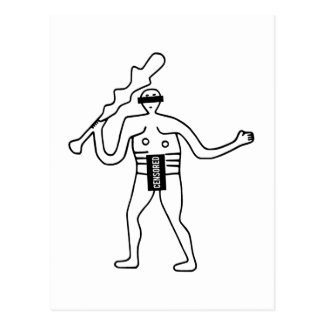
Famous beyond its local area, the Cerne Abbas Giant is a hillside sculpture of a giant man. With a clearly erect penis and a large brutish club, the naked barbarian is often said to be an ancient warrior-god of the ancestral tribes. This is a highly plausible explanation. There is one controversy, however, in which the first written records of the notable image is from the relatively recent 17th Century. The local parish has a record of payment for three shillings for the "repaireing of ye giant". An interesting fact is that at the time, Oliver Cromwell had recently overthrown the monarchy. He had been nicknamed the "English Hercules" in a mockery of his strong-man image. It is widely thought that the giant was intended as a satyrical cartoon of Cromwell himself. With the parish being a Royalist community, paying for its upkeep would make sense. The truth is hidden in the storybooks of history, probably never to be found. That is unless there is a secret society of ancient origins that still holds the key to its meaning.
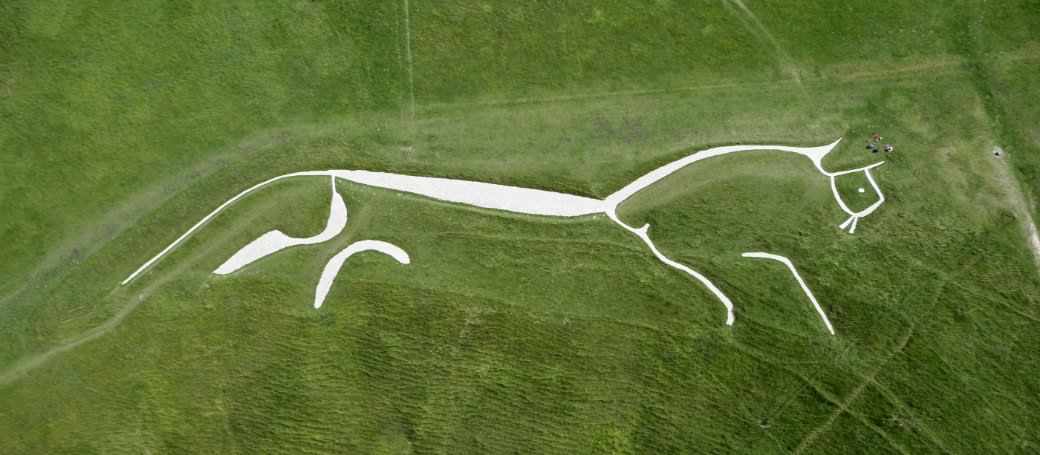
The Uffington Horse
In the chalky hills of Southern England, there are many images and figures cut into the grass. Because of the white colour of the underlying chalk, the images can be seen very easily thanks to the strong contrast. Many of the images were created in the nineteenth century as ornamental architecture however they were inspired by a few much older examples. It was unknown how old the White Horse of Uffington was until the 1990s. Considered to be Anglo-Saxon or Celtic according to various comparisons made to other art from those times, it was eventually determined by scientific analysis that the original image was cut in 1000 BC, during the Bronze Age.
Other hill art exists of a similar age, including the Giant Man at Cerne Abbas in Dorset and the Long Man of Wilmington, Sussex. The iconography of these images show what people of the time were thinking about, what was important, and what they wanted to be universal through-out their culture. Unifying a tribe or people through one memorable image helps communities to bond and also allows for identification of people we don't know. In historical records, other hill images are written about however they are now lost. Giants have once been depicted on the hills of Plymouth Hoe in Devon. There was also a Red Horse in Tysoe, Warwickshire. Because of the nature of the images, with grass growing all around them, it must have been the case that local residents have maintained them every year or two. The ancient artworks have been tended since their creation and even today the local residents can be found doing an annual cleanup.
|

Fantastic Britain: Myths And LegendsWritten by Rowan Blair Colver Categories
All
Download History eBooks anywhere you are. It's only history once it's written down! Have your say because it's important. Make your own Weebly site. 
|
